How to Learn Tarot Card Meanings Without Memorising
Seventy-eight cards is a lot to memorise and you do not have to. The structure that turns most of the deck into logic, and the habit that does the rest.
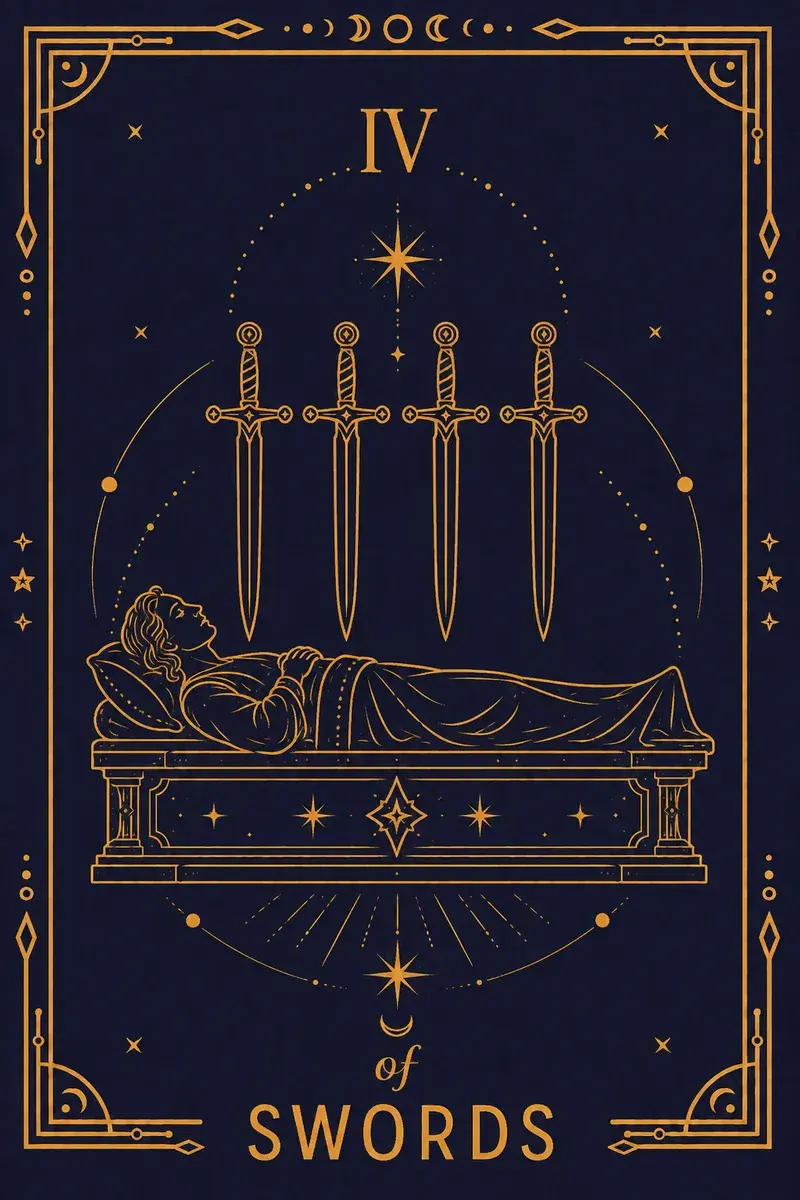 Four of Swords
Swords · Number 4
The Four is enforced rest after the Three. Retreat, recuperation, the mind put down. It is the suit's one genuinely restorative card and it arrives precisely when it is needed.
Affirmation
“I stop before I am stopped.”
The Four is enforced rest after the Three. Retreat, recuperation, the mind put down. It is the suit's one genuinely restorative card and it arrives precisely when it is needed.
Rest, recovery, a deliberate pause. Withdraw and recuperate. Not avoidance, convalescence. Meditation and sleep are the literal instruction.
Rest resisted, burnout building. Or coming out of a rest period and re-entering the world. Restlessness that will not let recovery finish.
A relationship on pause, space taken deliberately. Reversed, re-engagement after distance.
A break, sabbatical, sick leave. Stepping back before you are forced to. Reversed, returning to work, or refusing to stop.
Financial matters left alone deliberately. No action needed.
Contemplative retreat. Stillness as the practice rather than as preparation for practice.
The clearest "rest" card in the deck. Recovery, convalescence, sleep. Take it literally.
For reflection and entertainment. Not medical, legal, or financial advice.
A knight lies in effigy on a tomb, hands in prayer, one sword beneath him and three on the wall above. He is not dead. This is a church, and the stained glass shows a figure receiving a blessing.
Golden Dawn titled it Rest from Strife. The tomb-effigy composition is medieval funerary sculpture, which is why the card is so often misread as death; Waite was explicit that it means repose.
Written by Memento Arcana against the Rider-Waite-Smith deck and the Golden Dawn attributions it was built on. No part of it was generated by a language model. Last updated 7 August 2026.
Where traditions disagree about this card, the page says so rather than picking one quietly. How we write these, and our sources.
How Four of Swords has actually shown up for other readers.
Nothing here yet. Be the first to say how this card has landed for you.
Guides to reading this card alongside the other 77.
Seventy-eight cards is a lot to memorise and you do not have to. The structure that turns most of the deck into logic, and the habit that does the rest.
Two cards together mean more than two cards apart. A four-step method: dominant card, elements, the tension between them, then back to your question.
The 22 majors are the themes you do not choose. The 56 minors are daily life. What each half does, and what it means when one dominates a reading.