How to Learn Tarot Card Meanings Without Memorising
Seventy-eight cards is a lot to memorise and you do not have to. The structure that turns most of the deck into logic, and the habit that does the rest.
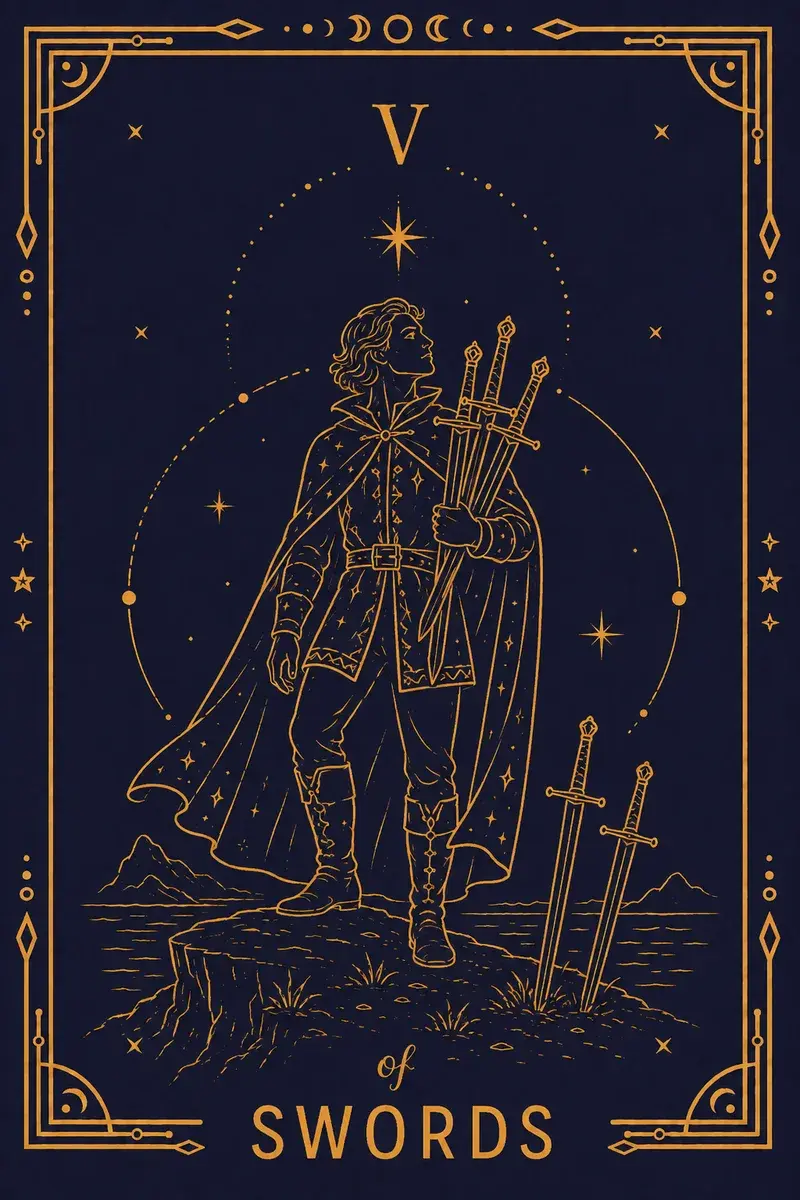 Five of Swords
Swords · Number 5
The Five is winning badly. The victory is real and it cost the relationship, the reputation, or the point. The card asks whether being right was worth what being right did.
Affirmation
“I would rather be in relationship than be right.”
The Five is winning badly. The victory is real and it cost the relationship, the reputation, or the point. The card asks whether being right was worth what being right did.
Conflict won at too high a price. Hollow victory, hostility, someone walking away. Ask what you are actually trying to achieve, because it is probably not this.
Making amends, or refusing to. Ongoing resentment. Sometimes: walking away from a fight you could win, which is the card's best possible outcome.
An argument that damages more than it settles. Point-scoring. Reversed, reconciliation, or a grudge with no expiry.
Office politics, a win that alienates the team, a colleague undermined. Reputational cost.
A financial dispute won at the cost of the relationship. Legal fees exceeding the claim.
The ego's appetite for being right. Humility as the actual objective.
Stress from ongoing conflict. The physical cost of sustained hostility.
For reflection and entertainment. Not medical, legal, or financial advice.
A smirking figure gathers swords while two others walk away with their backs turned, heads down. The sky is ragged. He has all the weapons and nobody is left.
Golden Dawn called it Defeat from the losers' perspective, notably, not the winner's. Smith's composition puts the victor in the foreground and gives him nothing worth having.
Written by Memento Arcana against the Rider-Waite-Smith deck and the Golden Dawn attributions it was built on. No part of it was generated by a language model. Last updated 7 August 2026.
Where traditions disagree about this card, the page says so rather than picking one quietly. How we write these, and our sources.
How Five of Swords has actually shown up for other readers.
Nothing here yet. Be the first to say how this card has landed for you.
Guides to reading this card alongside the other 77.
Seventy-eight cards is a lot to memorise and you do not have to. The structure that turns most of the deck into logic, and the habit that does the rest.
Two cards together mean more than two cards apart. A four-step method: dominant card, elements, the tension between them, then back to your question.
The 22 majors are the themes you do not choose. The 56 minors are daily life. What each half does, and what it means when one dominates a reading.