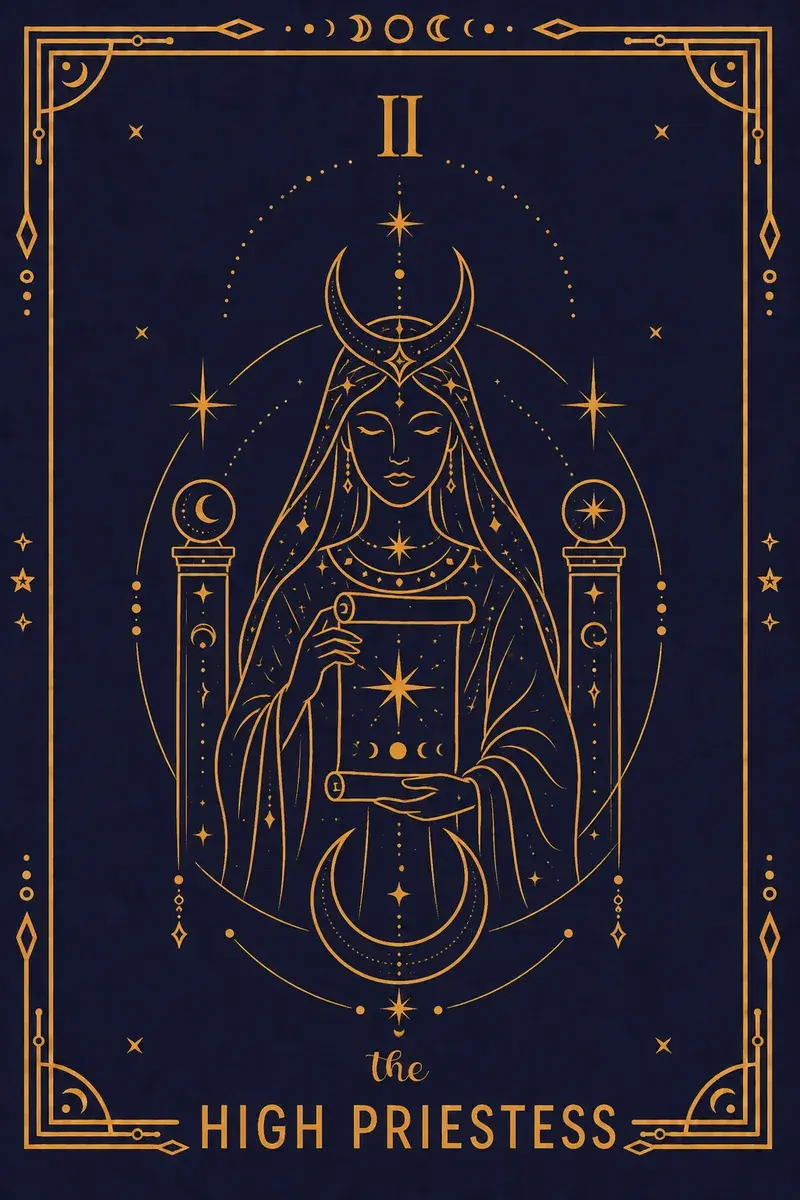
 The High Priestess
The High Priestess · Yes or No
Is The High Priestess a yes or a no?
The High Priestess in a yes/no reading, plus why the answer is less binary than the question wants it to be.
Not yet
This card does not answer cleanly either way. It points to something unresolved, unseen or still in motion, which in practice usually means "not yet" rather than "no".
The High Priestess guards what has not been spoken. She is the counterweight to The Magician: where he acts outward, she holds still and knows. This is the card of the answer you already have and have not admitted.
She sits at a threshold rather than in a room, between two pillars, with a veil behind her. Everything about the image is about a boundary between what is available and what is not, and she is on the near side of it holding the scroll half hidden. The card is not secretive for its own sake. It describes a thing that is not ready to be said, which is a different condition from a thing being hidden.
In a yes or no reading she is the clearest "not yet" in the deck, and readers who force her into a yes or a no are usually the ones who came with the answer already.
Why the answer is not really binary
Yes/no readings are the most popular use of tarot and the one it is worst suited to. A seventy-eight card deck built to describe nuance is being asked for one bit of information, and most of what it knows is discarded in the process.
A more useful version of the same draw: read The High Priestess as what shape this takes, not whether it happens. Trust the read you cannot yet justify. Withhold rather than explain. Something is being kept from you, or by you, and it is not yet time for it to come out. Study, dreams and inner work are favoured over external effort.
The specific instruction is against premature articulation. Saying a thing out loud fixes it, and this card describes a situation still forming, where fixing it early costs more than waiting. That applies to decisions, to feelings and to conclusions about other people.
It is also the deck's strongest card for taking your own quiet reaction seriously, including the one you cannot defend in argument. The tradition does not claim that instinct is always right. It claims that overruling it because you cannot justify it is its own kind of error.
Reversed
Reversed, the lean weakens or inverts. Disconnection from your own instinct: talking over it, outsourcing the decision, or ignoring a signal your body has already given you. It can also indicate secrets surfacing, or information deliberately withheld to your cost.
The first reading is the common one and it is uncomfortable, because it usually describes somebody who has asked a great many people what to do about something they already know. The card reversed is associated with the search for a second opinion that will license a decision already made.
The second is external and worth taking seriously when the surrounding cards are practical: terms nobody will put in writing, an arrangement explained differently to different people, a question that keeps not getting answered. Reversed, she stops guarding the secret and lets it out.
Draw it for yourself
Reading about a card is not the same as drawing one. A single-card reading takes about a minute and answers your question rather than a general one.
More on The High Priestess
- What does The High Priestess mean in love?
- What does The High Priestess mean for career and work?
- What does The High Priestess mean for money and finances?
- What does The High Priestess mean for health?
- What does The High Priestess mean as someone's feelings?
- What is The High Priestess advising?
- What does The High Priestess reversed mean?