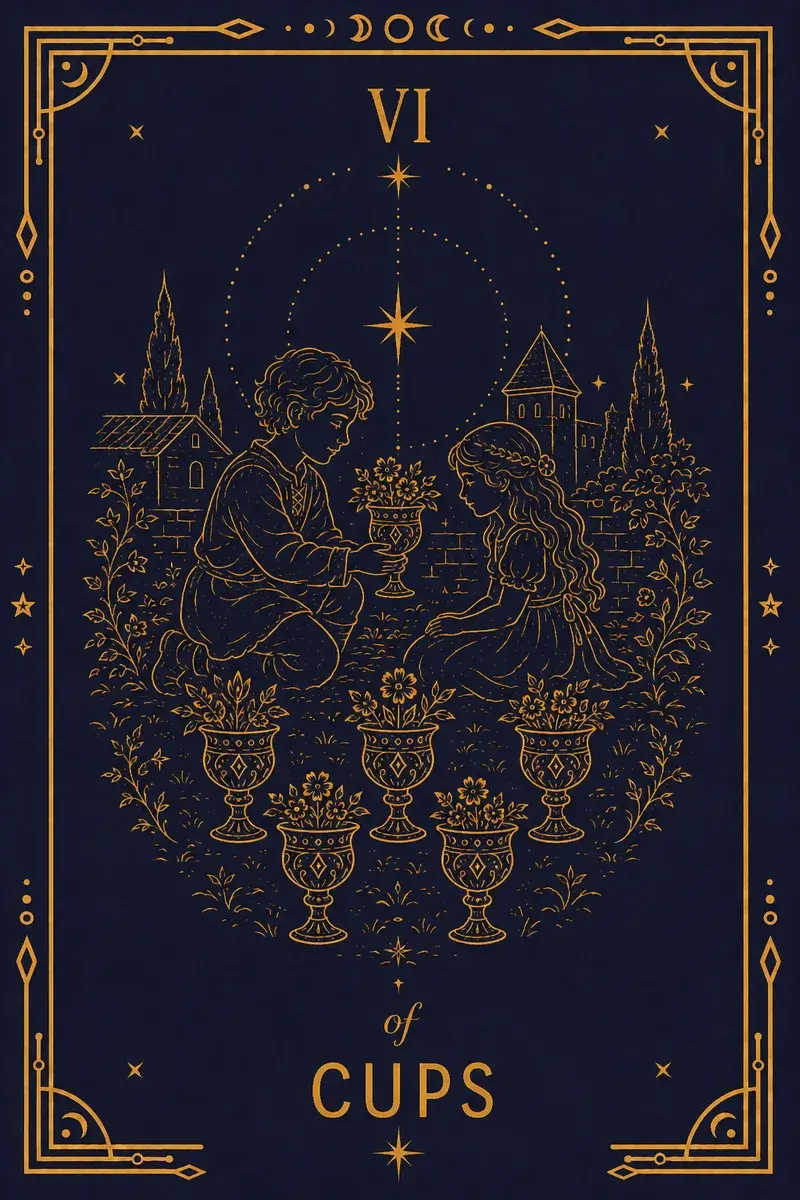
 Six of Cups
Six of Cups · Yes or No
Is Six of Cups a yes or a no?
Six of Cups in a yes/no reading, plus why the answer is less binary than the question wants it to be.
Yes
This card leans yes. It carries forward movement, and in a straight yes/no draw most readers take it affirmatively.
The Six is memory and innocence: childhood, nostalgia, kindness given without calculation.
It is warm and it is backward-looking, and the card holds both facts without resolving them. That refusal is the whole of it. Nothing here decides whether looking back is comfort or trap.
The detail that tips it is in the background. A guard is walking away from the walled garden, which is one of Smith's quiet compositional notes: the security in this picture is real and it is enclosed, and the walls that protect are the walls that limit.
Why the answer is not really binary
Yes/no readings are the most popular use of tarot and the one it is worst suited to. A seventy-eight card deck built to describe nuance is being asked for one bit of information, and most of what it knows is discarded in the process.
A more useful version of the same draw: read Six of Cups as what shape this takes, not whether it happens. Nostalgia, reunion, somebody from the past returning. Simple generosity, given without an eye on what comes back.
Also reconnecting with what you were like before you learned to be careful, which the tradition treats as retrieval rather than regression. Something was available to you once that is available again.
In an advice position it favours the uncalculated gesture: the message sent for no reason, the gift with no occasion, the kindness that gains you nothing. The card is old-fashioned about this and unembarrassed.
Reversed
Reversed, the lean weakens or inverts. Stuck in the past. Idealising something that was not that good, which is the reversal's speciality and is nearly impossible to see from inside.
Memory edits. A period recalled as golden was usually mixed at the time, and the card reversed describes a comparison being run against a version that never existed.
Or, more positively, finally moving forward and leaving it behind. Both readings are common, and the surrounding cards decide which. The second is frequently a relief that has been years arriving.
Draw it for yourself
Reading about a card is not the same as drawing one. A single-card reading takes about a minute and answers your question rather than a general one.