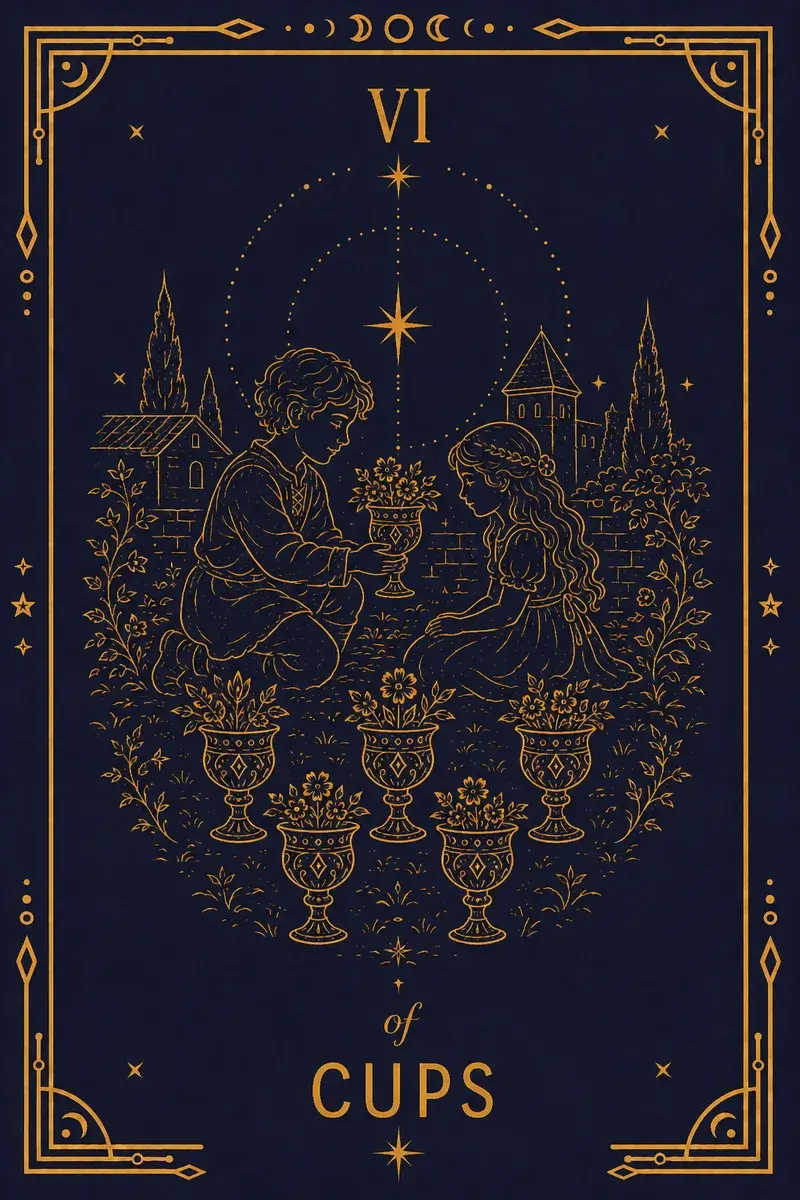
 Six of Cups
Six of Cups · In Money
What does Six of Cups mean for money and finances?
Six of Cups in a financial reading: what it says about your material situation and what it advises.
In money and finances
Money from the past: an inheritance, a returned debt, an old arrangement resurfacing. Gifts, given and received.
Associated with money that arrives rather than money that is earned, and with the particular complications of money that comes attached to family.
Reversed, an old financial arrangement that has quietly outlived its terms: the standing order to something no longer used, the loan nobody has mentioned in three years, the account from a former life.
Upright
Nostalgia, reunion, somebody from the past returning. Simple generosity, given without an eye on what comes back.
Also reconnecting with what you were like before you learned to be careful, which the tradition treats as retrieval rather than regression. Something was available to you once that is available again.
In an advice position it favours the uncalculated gesture: the message sent for no reason, the gift with no occasion, the kindness that gains you nothing. The card is old-fashioned about this and unembarrassed.
Reversed
Stuck in the past. Idealising something that was not that good, which is the reversal's speciality and is nearly impossible to see from inside.
Memory edits. A period recalled as golden was usually mixed at the time, and the card reversed describes a comparison being run against a version that never existed.
Or, more positively, finally moving forward and leaving it behind. Both readings are common, and the surrounding cards decide which. The second is frequently a relief that has been years arriving.
Keywords
Upright: nostalgia, innocence, memory, reunion, generosity
Reversed: stuck in the past, idealising, moving on, naivety
Journal prompts
- What am I remembering more fondly than it deserves?
- What did I do freely as a child that I now do only if it pays?
Draw it for yourself
Reading about a card is not the same as drawing one. A single-card reading takes about a minute and answers your question rather than a general one.