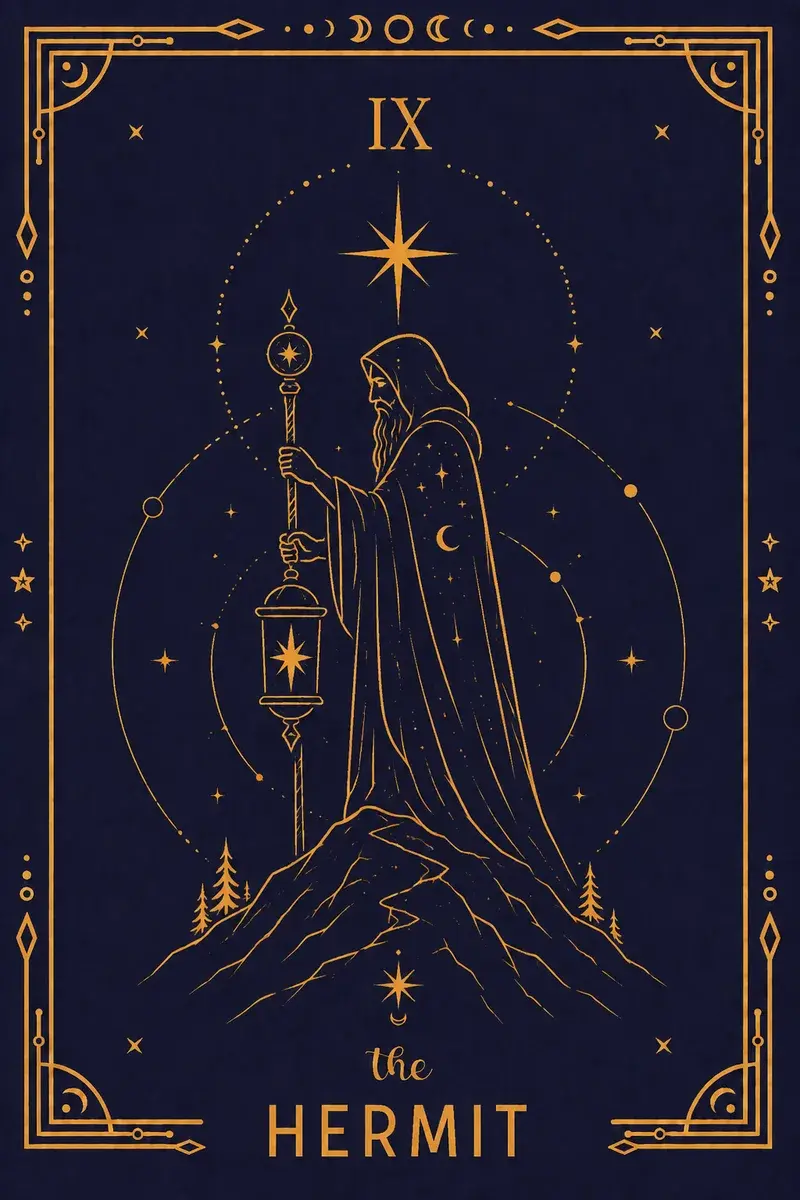
 The Hermit
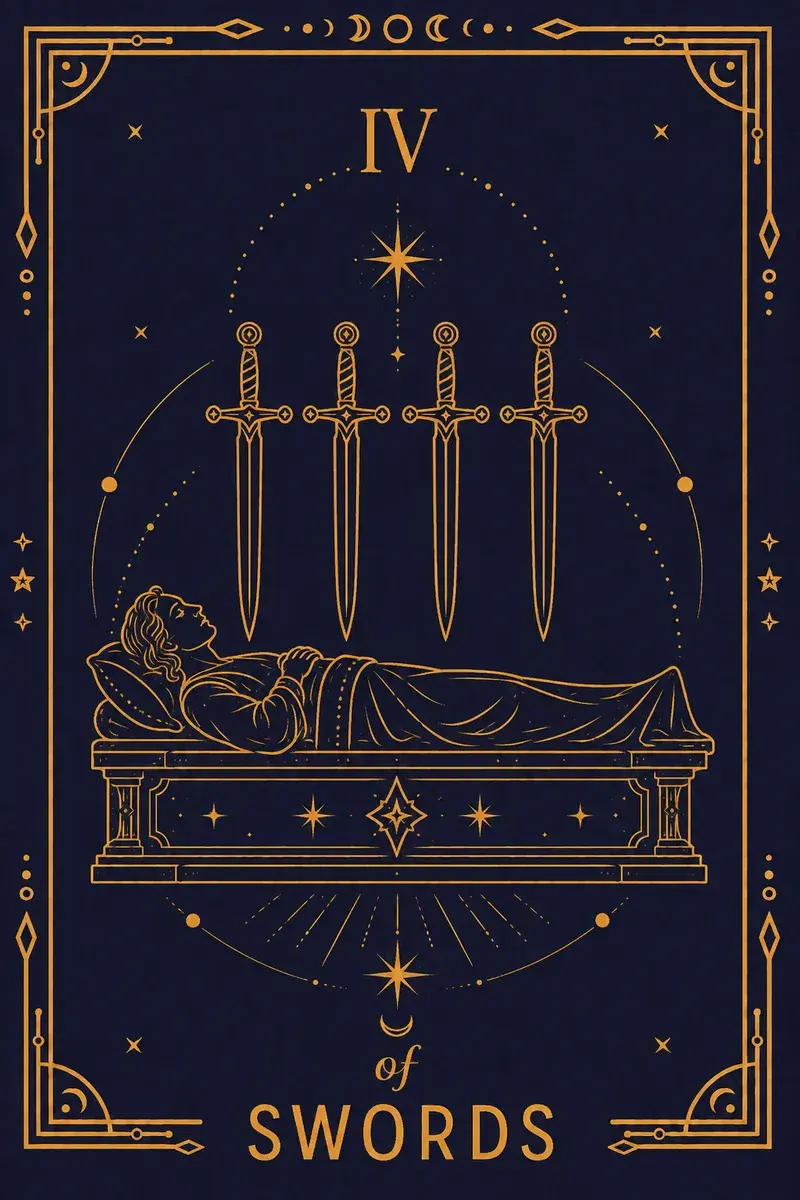 Four of Swords
Card combination
The Hermit and Four of Swords
The Hermit and Four of Swords together read as a single statement rather than two answers. Air and earth barely interact. Thought and material reality running in parallel without touching: plans that have not met practice, or practice nobody has thought about.
What each card brings
The Hermit brings solitude, introspection, guidance. Four of Swords brings rest, recovery, retreat. The reading lives in how those two sets meet.
The Hermit: The Hermit withdraws on purpose. This is not loneliness or avoidance. It is the deliberate removal of noise so that something can finally be heard. He carries his own light, which means the answer is not out there.
The lantern is the detail that governs the reading. It is small, it is held up rather than swung about, and it illuminates the next step and nothing further. The card does not offer a view of the whole road. It offers enough to move once, which is a more honest picture of how anybody actually proceeds.
He stands on a bare peak, which the tradition reads as achievement that turned out to be empty on its own. The Hermit is frequently the card of somebody who got what they were working towards and found the summit unpopulated.
Four of Swords: The Four is enforced rest after the Three: retreat, recuperation, the mind put down.
It is the suit's one genuinely restorative card and it arrives precisely when it is needed. The knight lies in effigy on a tomb and he is not dead.
The composition is medieval funerary sculpture, which is why the card is so often misread as death. Waite was explicit that it means repose. One sword lies beneath him and three hang on the wall above: the conflict has been put down rather than resolved, and the stained glass behind shows a figure receiving a blessing.
How they interact
The Hermit is a Major Arcana card and Four of Swords is a minor. Read the major as the underlying force and the minor as how it is showing up in daily life. The major sets the weather, the minor is what you are doing about it.
Earth and Air
Air and earth barely interact. Thought and material reality running in parallel without touching: plans that have not met practice, or practice nobody has thought about.
In a love reading
The Hermit: Time alone, whether chosen or imposed. A relationship needing space rather than intensity, or a period of being single that is doing something rather than merely lasting.
The tradition is notably unbothered by this card in a love reading, which surprises people who draw it hoping for something warmer. Its position is that a period alone is a normal part of a life and frequently a productive one, and that the pressure to be partnered is not coming from the deck.
Within a relationship it describes one person needing distance without it meaning anything more than that. Reversed, emotional unavailability, or somebody who has withdrawn so far they cannot be reached. The distinction between needing space and disappearing is the whole question, and it usually turns on whether the person can say when they are coming back.
As somebody's feelings, it reads as private and considered rather than absent. Something is being thought about carefully and is not being shared yet, which is not the same as nothing being there.
Four of Swords: A relationship on pause, with space taken deliberately rather than through conflict.
The card describes distance that is doing something: one or both people stepping back to recover from a hard period. It is not a break-up card and it is frequently mistaken for one.
Reversed, re-engagement after distance, which is the good reading, or a pause that has been resisted until it becomes an argument.
As somebody's feelings, it reads as withdrawn but not gone: this person needs quiet, and their absence is about their own state rather than about you. That is often true and is very hard to believe from the outside.
In a career reading
The Hermit: Solo work, research, expertise built in private. A sabbatical or a deliberate step out of the race. Good for mentoring, consultancy and anything where depth beats visibility.
Virgo pulls it towards craft and precision: the specialist, the analyst, the person who knows one thing extremely well and is not interested in managing anybody. It is a poor card for visibility, promotion and networking, and it does not treat that as a loss.
The practical reading is that the next step is study rather than action, and that the pressure to be seen to be doing something is the thing to resist. In a stuck career it often points at a period of quiet skill-building that nobody will notice for a year.
Four of Swords: A break, a sabbatical, sick leave. Stepping back before you are forced to.
The card is emphatic about the order of those two. Rest taken deliberately is shorter than rest imposed by collapse, and the tradition treats the choice as available for longer than most people believe.
Reversed, returning to work, or refusing to stop. In a stuck career this card rarely suggests a strategy; it suggests that the exhaustion is the reason nothing has been solvable.
Reversed
If either card comes out reversed the pairing shifts.
The Hermit reversed: Isolation that has curdled, withdrawal as hiding, loneliness rather than solitude. Or the reverse: so much noise and company that no reflection is possible.
Both are common and they are opposites, which makes the surrounding cards unusually important. The first is somebody who went quiet for a reason that has expired and cannot find the way back; the second is somebody so surrounded that they have not had an unobserved thought in months.
The kinder and often correct reading is that the retreat has served its purpose and it is time to come back. The Hermit reversed is not always a warning. It is frequently permission.
Four of Swords reversed: Rest resisted, burnout building.
Or coming out of a rest period and re-entering the world, which is the benign version and is often accompanied by more anxiety than the rest itself.
Also read for restlessness that will not let recovery finish: getting up too early, returning to work at sixty percent, treating convalescence as time to be made up. The card is clear that an interrupted recovery restarts rather than continues.