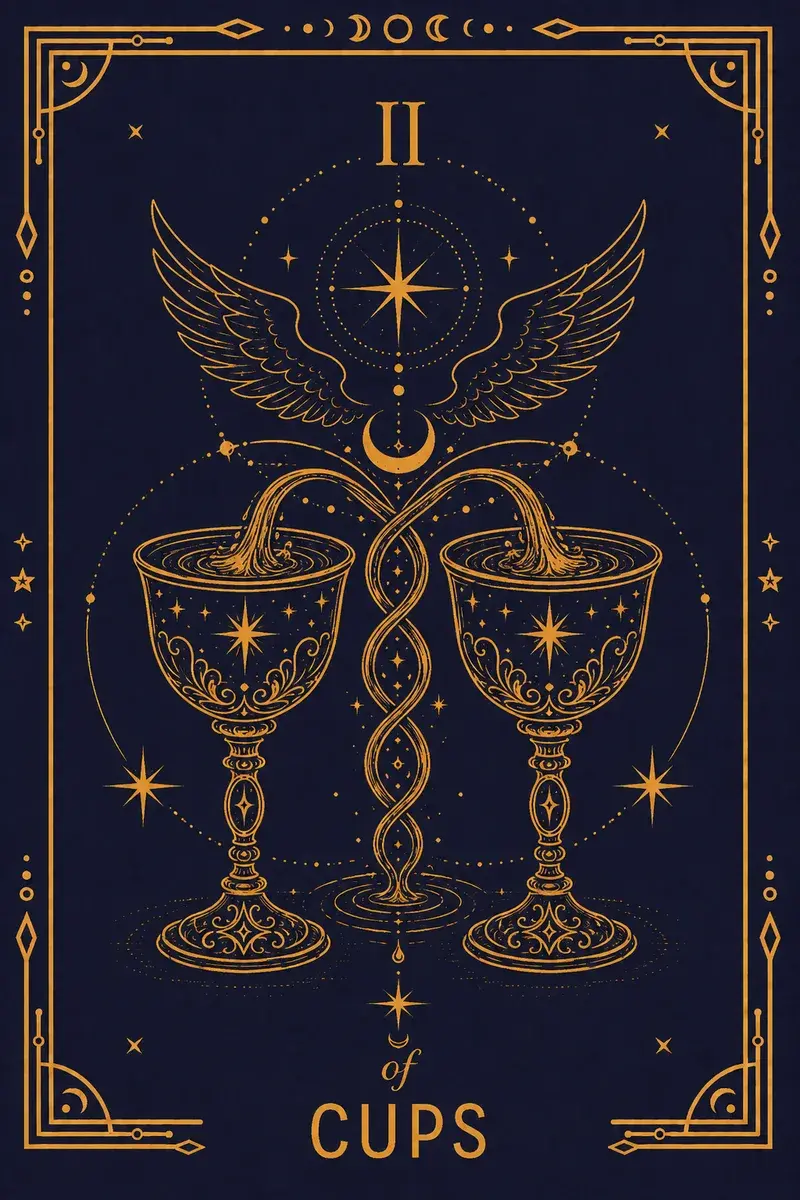
 Two of Cups
Two of Cups · Yes or No
Is Two of Cups a yes or a no?
Two of Cups in a yes/no reading, plus why the answer is less binary than the question wants it to be.
Yes
This card leans yes. It carries forward movement, and in a straight yes/no draw most readers take it affirmatively.
The Two is mutual recognition. Two people meeting as equals and each choosing the other.
It is the minor-arcana echo of The Lovers, scaled down from destiny to an actual relationship between two actual people, and the reduction is a gain rather than a loss. The Lovers asks what a union costs; the Two of Cups describes the union working.
The gesture in the picture is symmetrical, and that is the whole card. Neither figure is offering more than the other, and the caduceus rising between them, topped with a winged lion's head, is healing produced by the exchange itself rather than by either person.
Why the answer is not really binary
Yes/no readings are the most popular use of tarot and the one it is worst suited to. A seventy-eight card deck built to describe nuance is being asked for one bit of information, and most of what it knows is discarded in the process.
A more useful version of the same draw: read Two of Cups as what shape this takes, not whether it happens. Partnership, attraction, a bond formed in balance. Reconciliation after a break.
What distinguishes it from every other connection card is reciprocity. Whatever is being offered here is being offered both ways, and the tradition treats that as the mechanism rather than a happy accident: the thing works because it is even.
In an advice position it favours meeting somebody halfway and saying so out loud. It is a poor card for waiting to be approached and a good one for the conversation that formalises something already true.
Reversed
Reversed, the lean weakens or inverts. Imbalance: one giving, one taking. A break, a falling-out, or a connection that never becomes mutual.
The distinguishing question is whether the asymmetry is temporary. Every relationship spends periods uneven, and the card reversed describes the state where it has stopped correcting: one person adjusting continuously while the other does not notice there is anything to adjust.
Sometimes it reads as self-regard needing to come first, which is the gentler version and appears where somebody has been meeting everybody halfway and nobody has been walking towards them.
Draw it for yourself
Reading about a card is not the same as drawing one. A single-card reading takes about a minute and answers your question rather than a general one.