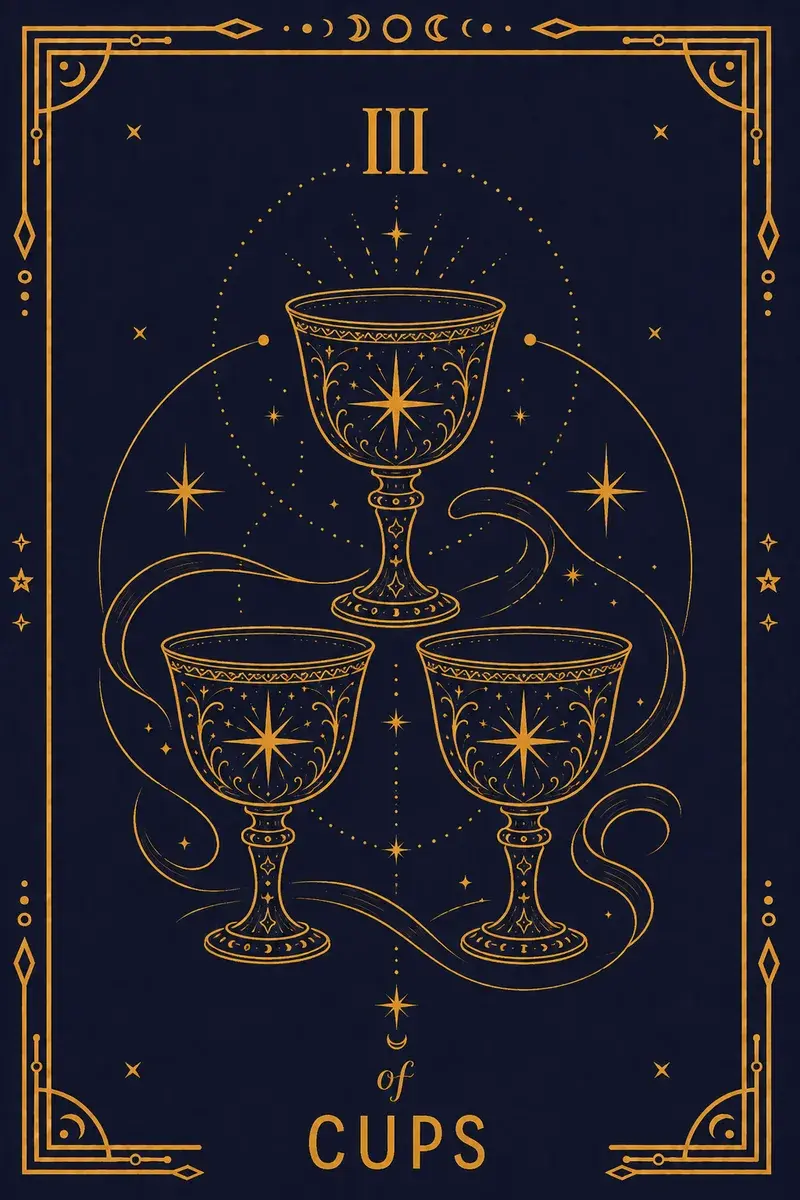
 Three of Cups
Three of Cups · Yes or No
Is Three of Cups a yes or a no?
Three of Cups in a yes/no reading, plus why the answer is less binary than the question wants it to be.
Yes
This card leans yes. It carries forward movement, and in a straight yes/no draw most readers take it affirmatively.
The Three is joy shared out: friendship, celebration, and the particular happiness that only exists between more than two people.
It is community as emotional nourishment rather than obligation, which is the distinction that decides the reading. The same gathering can be either, and the card upright is always the first.
The composition is closed. Three women stand in a circle turned towards each other, feet in a harvest field, and that closure is the warmth of the card upright and its exclusion reversed. The picture does not change; where you are standing relative to it does.
Why the answer is not really binary
Yes/no readings are the most popular use of tarot and the one it is worst suited to. A seventy-eight card deck built to describe nuance is being asked for one bit of information, and most of what it knows is discarded in the process.
A more useful version of the same draw: read Three of Cups as what shape this takes, not whether it happens. Celebration, friendship, reunion. Good news worth telling people. Collaboration that is genuinely fun.
Its instruction is unusually simple: accept the invitation. The card is associated with the thing that gets declined because of tiredness or work and turns out to have been the important part of the month.
It also favours saying the good news out loud rather than waiting to be asked. Three of Cups is the card of announcing something, and the tradition treats an unshared joy as a diminished one.
Reversed
Reversed, the lean weakens or inverts. Overindulgence, or the third party in a two-person situation.
Also social exhaustion, gossip, and a friendship group that has become draining rather than restorative. That last is the most useful and the least dramatic: a circle maintained out of history rather than pleasure, where everybody is slightly relieved when it is cancelled.
The third-party reading is traditional and worth handling carefully. It describes a configuration rather than an accusation, and it turns up as often for a demanding friend or a relative as for anything romantic.
Draw it for yourself
Reading about a card is not the same as drawing one. A single-card reading takes about a minute and answers your question rather than a general one.