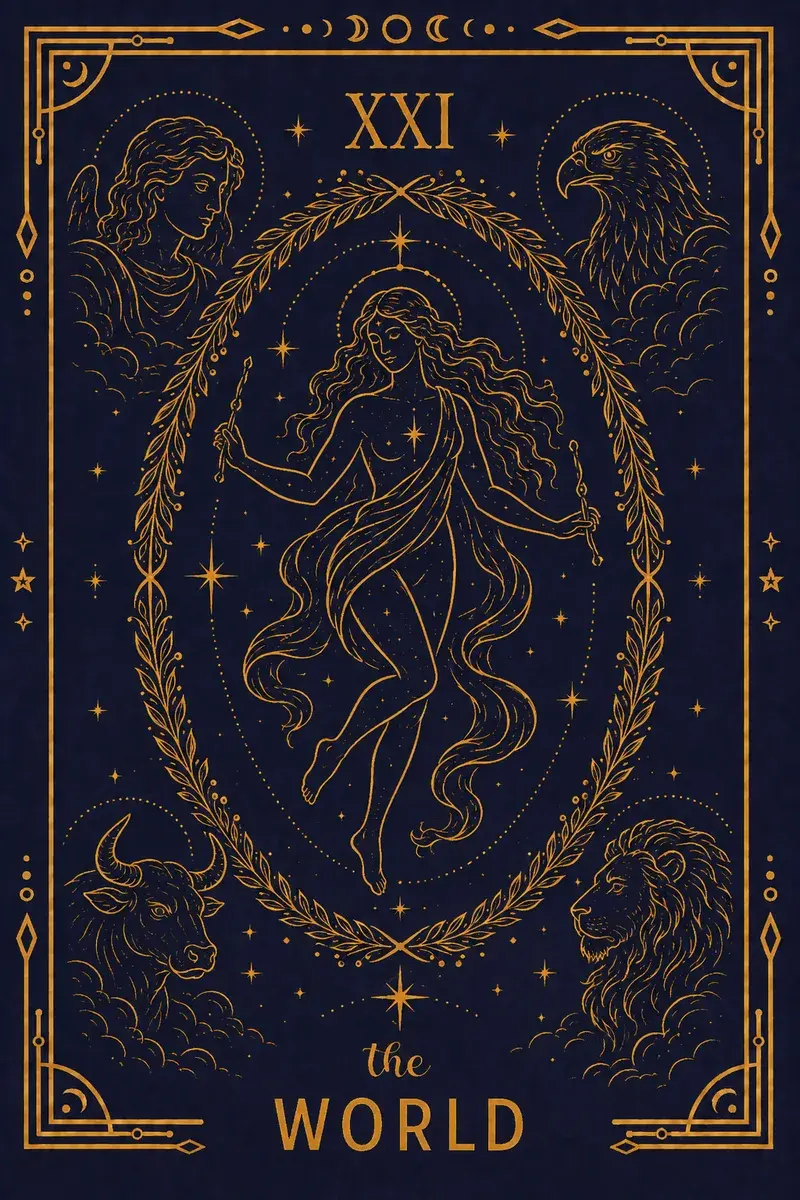
 The World
The World · Yes or No
Is The World a yes or a no?
The World in a yes/no reading, plus why the answer is less binary than the question wants it to be.
Yes
This card leans yes. It carries forward movement, and in a straight yes/no draw most readers take it affirmatively.
The World is completion: the whole circuit walked, the thing actually finished. It is the deck's last trump and its most satisfied.
The wreath around the dancer is an ellipse, a zero, the shape The Fool began at. Waite designed the two cards to mirror each other deliberately, which is why many readers treat the majors as a loop rather than a line, and why this card carries the quiet implication that a completed cycle is also a doorway.
The figure holds two wands where The Magician held one. The same power, now balanced in both hands, at the end of the road rather than the start of it.
Why the answer is not really binary
Yes/no readings are the most popular use of tarot and the one it is worst suited to. A seventy-eight card deck built to describe nuance is being asked for one bit of information, and most of what it knows is discarded in the process.
A more useful version of the same draw: read The World as what shape this takes, not whether it happens. Fulfilment, integration, an achievement genuinely earned. A chapter closes well.
Travel and international matters are indicated literally, and that reading is old enough and consistent enough to be worth keeping alongside the symbolic one.
What separates this from the deck's other good cards is that it describes something finished rather than something going well. That is rarer and it asks for a particular response: marking it, rather than immediately beginning the next thing, which is the one instruction people reliably skip.
Reversed
Reversed, the lean weakens or inverts. So close. An incomplete ending, a loose thread, a goal reached without the satisfaction expected.
The anticlimax reading is the most common and the most human. The thing was achieved, nothing changed internally, and the person is quietly wondering what the point was. The card reversed treats that as information rather than ingratitude.
It can also mean seeking closure externally that only exists internally: waiting for an apology, an acknowledgement or a conversation that would complete something, from somebody who is not going to provide it.
Draw it for yourself
Reading about a card is not the same as drawing one. A single-card reading takes about a minute and answers your question rather than a general one.