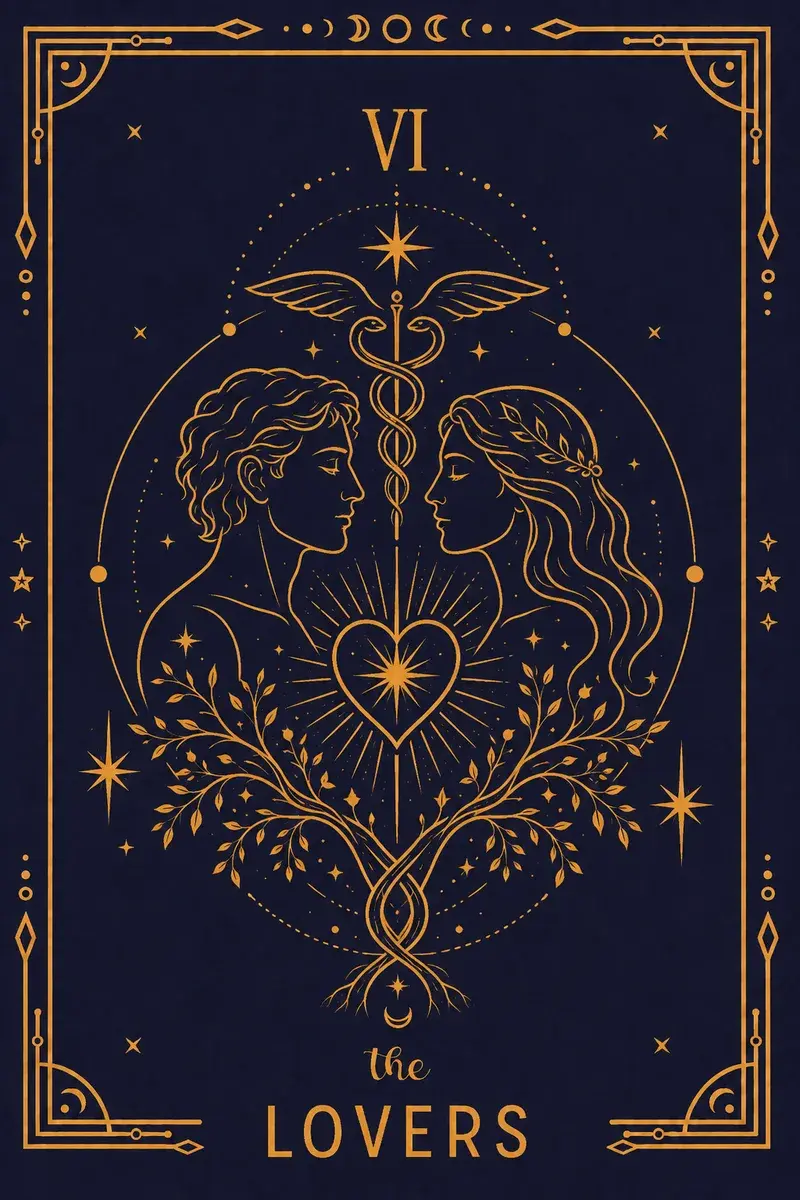
 The Lovers
The Lovers · Yes or No
Is The Lovers a yes or a no?
The Lovers in a yes/no reading, plus why the answer is less binary than the question wants it to be.
Yes
This card leans yes. It carries forward movement, and in a straight yes/no draw most readers take it affirmatively.
The Lovers is about union and, inseparably, about choice. Every real union excludes something. The card is far less about romance than its name suggests: it is about the decision that defines who you are becoming.
The Marseille version made this explicit, with a young man standing between two women and Cupid overhead, and it was read as virtue against vice. Waite replaced it with Eden, which shifts the question from which one to what does this cost, and both readings survive in modern practice.
The name is the most misleading thing about the card. People draw it hoping for a verdict on a relationship and receive instead a question about their own values, which is usually the more useful of the two and rarely the more welcome.
Why the answer is not really binary
Yes/no readings are the most popular use of tarot and the one it is worst suited to. A seventy-eight card deck built to describe nuance is being asked for one bit of information, and most of what it knows is discarded in the process.
A more useful version of the same draw: read The Lovers as what shape this takes, not whether it happens. Alignment with a person, a path, or your own values. A meaningful connection, or a choice made in full knowledge of what it forecloses. Whatever you decide here should be decided on values, not convenience.
The emphasis on knowledge is deliberate. The tradition does not read this card as a good decision; it reads it as an informed one, made by somebody who can say what they are giving up. A choice that avoids naming its cost is the reversal, whatever its outcome.
In an advice position it is one of the most demanding cards in the deck: decide on the grounds you would defend out loud, rather than on the grounds that are actually operating. Most people can tell the difference immediately when asked.
Reversed
Reversed, the lean weakens or inverts. Misalignment. A relationship built on avoidance, a choice made to dodge a harder one, or values in open conflict with behaviour. Also indecision that has become its own decision by default.
The last of those is the commonest and the most quietly damaging. Waiting is not neutral; it is a choice made slowly, with the advantage that nobody has to be responsible for it. The card reversed is unusually pointed about this.
Also read for a decision made on the wrong axis entirely: choosing on money when the question was about values, or on values when the question was genuinely about money. The reversal is not always about doing the wrong thing. It is often about answering a question nobody asked.
Draw it for yourself
Reading about a card is not the same as drawing one. A single-card reading takes about a minute and answers your question rather than a general one.