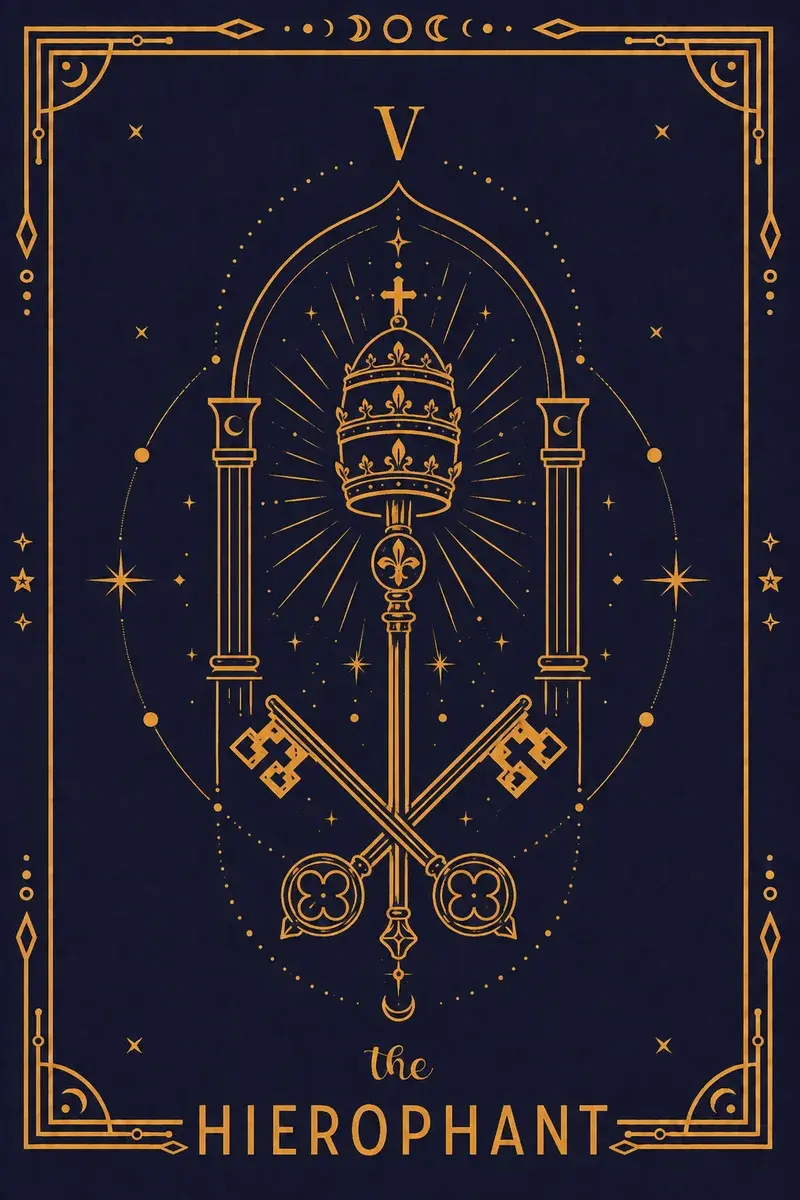
 The Hierophant
The Hierophant · In Love
What does The Hierophant mean in love?
The Hierophant in a love or relationship reading. What it says about connection, what it asks of you, and how it changes upright versus reversed.
In love and relationships
Commitment with a public shape: marriage, meeting family, shared belief, the relationship that other people now know about. He is the most traditional partnership card in the deck and the one most concerned with the form a relationship takes rather than its feeling.
That is his strength and his limit. The Hierophant describes the part of a couple that is an institution: the arrangement, the expectations, the two families, what would have to be undone if it ended. All of that is real, and it is not the same thing as whether two people are happy.
Reversed, a relationship straining against expectation, or two people with incompatible values pretending that is a small thing. The second is the one worth taking seriously. Values that differ quietly for years tend to surface around a decision, and the card is often the warning before the decision rather than after it.
As somebody's feelings, he reads as serious intent of a conventional kind: this person is thinking about it in terms of what it would become rather than how it feels this week.
Upright
Learn from someone who came before. Formal study, mentorship, ritual, marriage, religion, qualification. This card says the conventional path is genuinely the right one here, which is not something tarot says often.
That is worth dwelling on, because most of the deck is biased towards individuation and this card is not. Its counsel is that the situation you are in has been in front of other people before, that they wrote down what they found, and that reading it will cost you an afternoon and save you a year.
In an advice position he is specific: find the person who already knows, and let them correct you. He also favours doing things in the recognised order, including the tedious parts, on the grounds that the order usually exists for a reason.
Reversed
The tradition no longer fits. Dogma without meaning, a teacher who should not be followed, rules kept out of habit. It also marks the point where you become your own authority: necessary, and rarely comfortable.
The second reading is the important one and the tradition is not defensive about it. Every lineage produces people who outgrow it, and the card reversed describes that moment without treating it as betrayal. It is uncomfortable because it removes a structure that was genuinely holding something.
The darker reading, where the surrounding cards support it, is authority that should not be trusted with the position it holds. The card does not flinch from that either, and it is worth reading plainly rather than softening when it appears next to something difficult.
Keywords
Upright: tradition, institutions, mentorship, conformity, ritual, education
Reversed: dogma, rebellion, unorthodoxy, broken convention, bad teaching
Journal prompts
- Whose approval am I still working to earn?
- Which belief did I inherit rather than choose?
- Where would a teacher save me years of avoidable error?
Draw it for yourself
Reading about a card is not the same as drawing one. A single-card reading takes about a minute and answers your question rather than a general one.