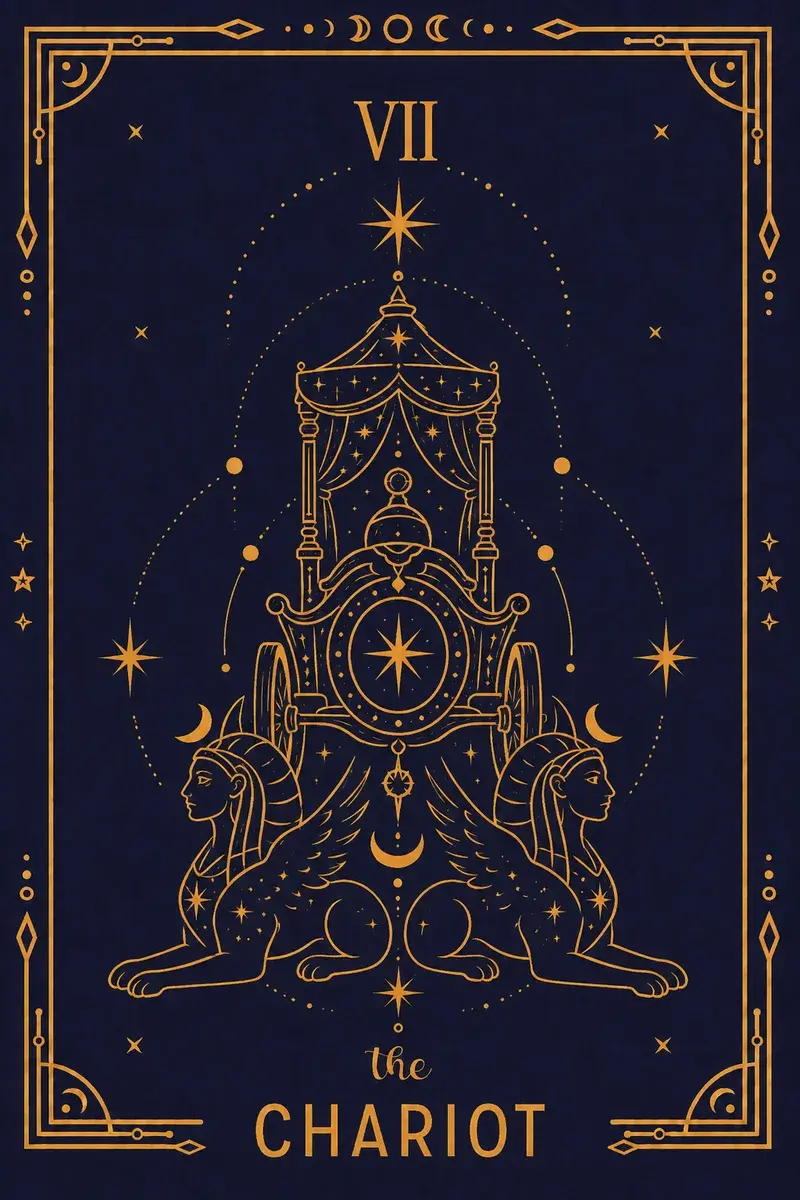
 The Chariot
The Chariot · Yes or No
Is The Chariot a yes or a no?
The Chariot in a yes/no reading, plus why the answer is less binary than the question wants it to be.
Yes
This card leans yes. It carries forward movement, and in a straight yes/no draw most readers take it affirmatively.
The Chariot is forward motion held together by will. Two opposing forces are yoked and driven in one direction, and nothing about that is effortless. The control is active, and it has to be maintained the whole way.
The detail that carries the card is that the charioteer holds no reins. The sphinxes are moved by will alone, and they are pulling different ways. Nothing in the picture suggests this arrangement is stable; it suggests it is being held, continuously, by the person standing in it.
The chariot is also not shown moving. The tradition reads the card as the tension itself rather than as the journey, which is why it fits situations that require sustained effort to stay on course far better than it fits arrivals.
Why the answer is not really binary
Yes/no readings are the most popular use of tarot and the one it is worst suited to. A seventy-eight card deck built to describe nuance is being asked for one bit of information, and most of what it knows is discarded in the process.
A more useful version of the same draw: read The Chariot as what shape this takes, not whether it happens. Determination, momentum, a hard-won victory. Focus everything on one direction and go. This is the card of travel, of campaigns, and of the discipline it takes to hold a course when the pieces pulling you would rather scatter.
Its particular strength is in situations with genuine internal opposition: part of you wants this and part of you does not, and the card says go anyway, without waiting for the disagreement to resolve. It never claims the sphinxes agree. It claims they can be driven.
In an advice position it favours one direction over several, a deadline over an open horizon, and finishing over reconsidering. It is a poor card for anything that would benefit from being reopened.
Reversed
Reversed, the lean weakens or inverts. Loss of direction, or force without steering. Spinning the wheels. It can mean aggression standing in for competence, or a will so tight that everything around it has started to crack.
The most useful version of the reversal is the second: effort that has become a substitute for thinking. Somebody working extremely hard in a direction nobody has checked recently is the characteristic picture, and it is hard to spot from inside because the effort feels like evidence.
Also read for the sphinxes winning, where the opposing pulls have taken over and the vehicle is going somewhere nobody chose. That is the version where stopping, which the card upright refuses to consider, becomes the correct move.
Draw it for yourself
Reading about a card is not the same as drawing one. A single-card reading takes about a minute and answers your question rather than a general one.