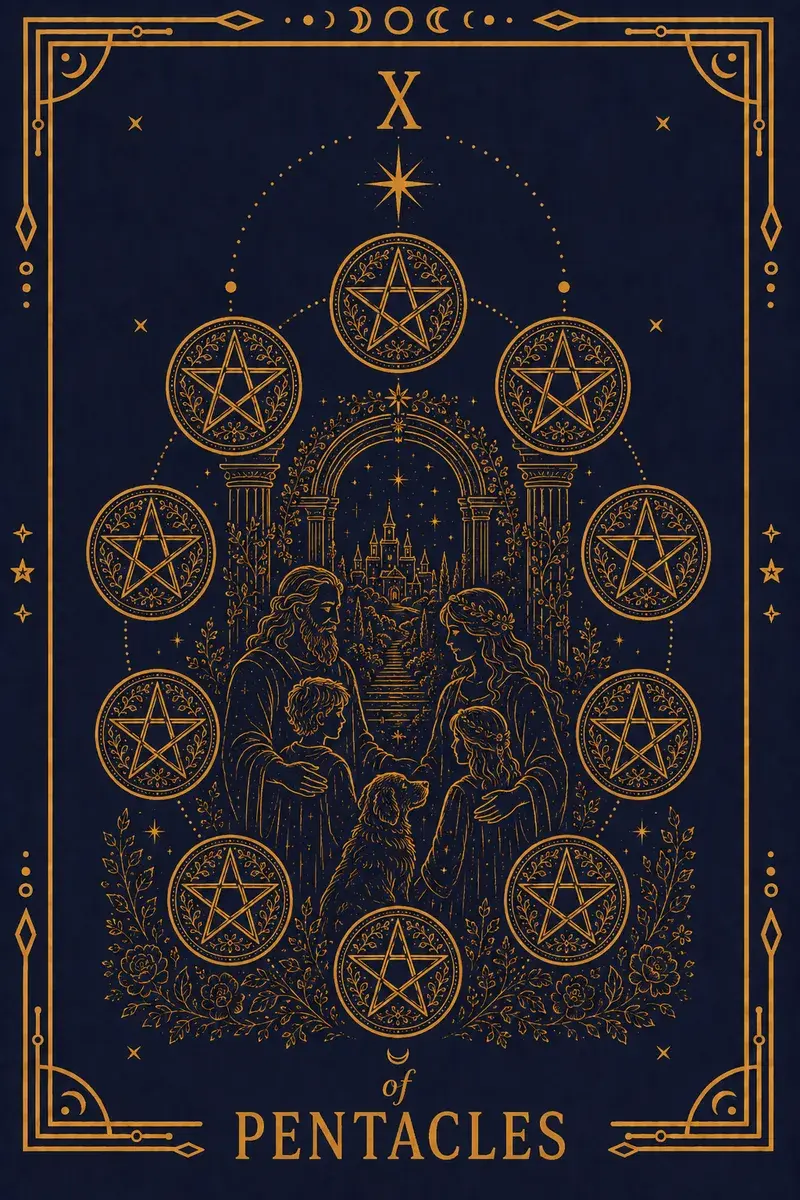
 Ten of Pentacles
Ten of Pentacles · In Money
What does Ten of Pentacles mean for money and finances?
Ten of Pentacles in a financial reading: what it says about your material situation and what it advises.
In money and finances
Inheritance, generational wealth, property. Financial security that is structural rather than personal.
The distinction is the card's contribution: money that is arranged rather than earned, held in things rather than in an account, and largely outside the control of any one person in the picture.
Its practical counsel is unglamorous and genuinely important. Wills, beneficiaries and who has access to what are the things families most reliably leave undone, and the reversal of this card is very often the consequence.
Upright
Lasting security, family wealth, legacy. Long-term stability across generations.
What you are building will outlast the building of it, which is the card's claim and its comfort. This is the most permanent thing the deck describes.
In an advice position it favours the decision made for a timescale longer than your own: the will written, the thing set up properly, the arrangement that will still work when nobody remembers why it was made that way.
Reversed
Family conflict over money. Instability beneath an established surface.
The first is one of the most common real situations this card describes, and it is rarely about the money. Inheritance disputes are about recognition, and the sums involved are frequently trivial compared to what is being argued over.
Also read for a legacy that constrains rather than provides: the business that has to be continued, the house that cannot be sold, the expectation attached to a gift.
Keywords
Upright: legacy, family wealth, lasting security, inheritance, tradition
Reversed: family conflict, instability, constraining legacy, lost wealth
Journal prompts
- What am I building that will outlast me?
- What did I inherit, materially or otherwise, and what will I do with it?
Draw it for yourself
Reading about a card is not the same as drawing one. A single-card reading takes about a minute and answers your question rather than a general one.