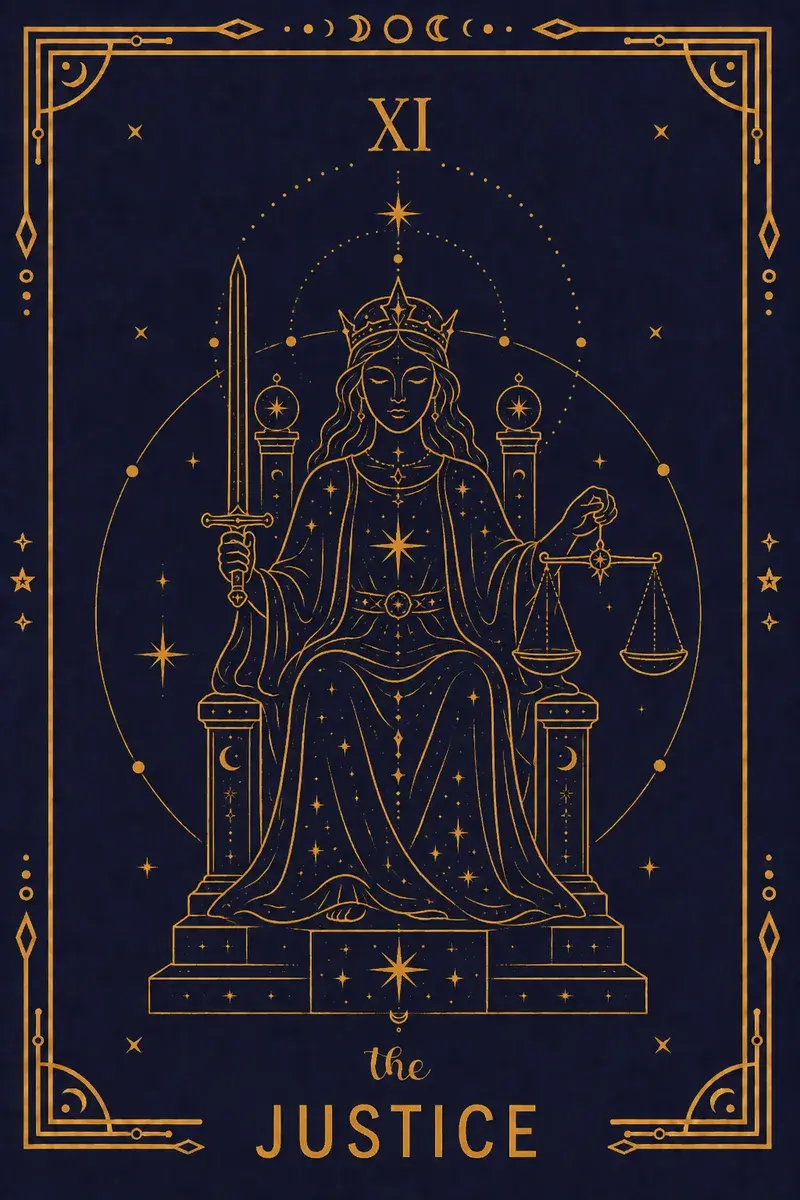
 Justice
Justice · Yes or No
Is Justice a yes or a no?
Justice in a yes/no reading, plus why the answer is less binary than the question wants it to be.
Not yet
This card does not answer cleanly either way. It points to something unresolved, unseen or still in motion, which in practice usually means "not yet" rather than "no".
Justice is cause and effect made visible. It is not about fairness in the sense of what you deserve. It is about consequence in the sense of what follows. The scales measure, and the sword acts on the measurement.
That distinction is the whole card and it disappoints people. Justice does not promise that you will get what you should have; it describes what proceeds from what has actually happened. Those are different, and the second is the one the deck can speak to.
Unlike almost every other depiction of the figure, she is not blindfolded. She sees everything, including the circumstances and the excuses, and rules anyway. One foot is already out from under the robe, ready to move.
Why the answer is not really binary
Yes/no readings are the most popular use of tarot and the one it is worst suited to. A seventy-eight card deck built to describe nuance is being asked for one bit of information, and most of what it knows is discarded in the process.
A more useful version of the same draw: read Justice as what shape this takes, not whether it happens. Truth, accountability, a decision made on the facts. Legal matters resolve. Take responsibility for your part, and expect others to be held to theirs. What is owed will be settled.
The order of the tools matters: scales first, then sword. The card weighs before it acts, and its counsel in a hurried situation is that the weighing has not been done properly yet.
In an advice position it is exacting and narrow: own your part, exactly and no more. Justice has as little patience with somebody taking on blame that is not theirs as with somebody dodging blame that is, and the second is only marginally more common than the first.
Reversed
Reversed, the lean weakens or inverts. Unfairness, avoided accountability, a dishonest account of events. Bias dressed as objectivity. It can also mean legal trouble, delayed rulings, or a judgement you will not accept.
The most useful reading is the account rather than the outcome: a version of events that has been arranged, by somebody, into a shape that produces a particular conclusion. That is often done sincerely, which is what makes it hard to argue with.
Also read for a fair process reaching a result you cannot accept, which the card treats as a real and separate situation. Reversed does not automatically mean somebody cheated.
Draw it for yourself
Reading about a card is not the same as drawing one. A single-card reading takes about a minute and answers your question rather than a general one.