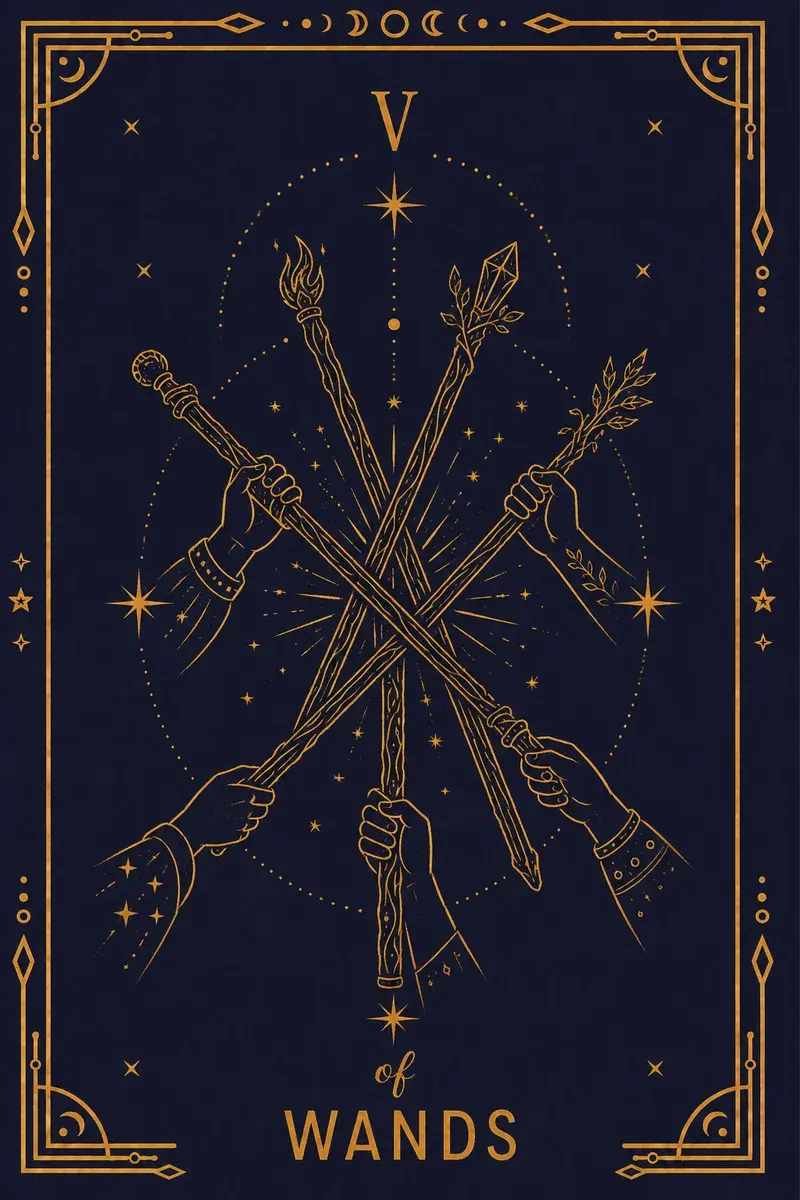
 Five of Wands
Five of Wands · In Love
What does Five of Wands mean in love?
Five of Wands in a love or relationship reading. What it says about connection, what it asks of you, and how it changes upright versus reversed.
In love and relationships
Petty friction and clashing needs. Nothing fundamental, and nothing being addressed either.
The card describes the accumulation of small unresolved things: the same disagreement about the same domestic subject, conducted with increasing efficiency and no progress.
What it points at is structure rather than feeling. Most of what this card describes is solved by two people deciding who does what, and almost none of it is solved by another round of the argument.
Reversed, tension defused, or resentment driven underground.
As somebody's feelings, it reads as agitated and unresolved: this person is contending with something, quite possibly not primarily about you.
Upright
Competition, disagreement, everybody talking over each other.
Not a fight to the death: a scramble. That distinction changes what to do about it, because a scramble is a coordination problem rather than a moral one.
It is often productive if somebody imposes structure on it, which is the card's most useful practical note. Five people with different ideas is a resource until nobody chairs the meeting.
Reversed
Conflict avoided rather than resolved, or genuinely ended.
The avoidance version is the more common and produces a quiet that everybody mistakes for agreement, until the same argument arrives attached to something trivial.
It can also mean inner conflict: competing impulses fighting internally instead of out loud, which is the same scrimmage with one participant and no possibility of a chair.
Keywords
Upright: conflict, competition, friction, disagreement, chaos
Reversed: avoided conflict, resolution, inner conflict, exhaustion
Journal prompts
- Is this conflict about the thing we are arguing about?
- Where am I competing when I could be collaborating?
Draw it for yourself
Reading about a card is not the same as drawing one. A single-card reading takes about a minute and answers your question rather than a general one.