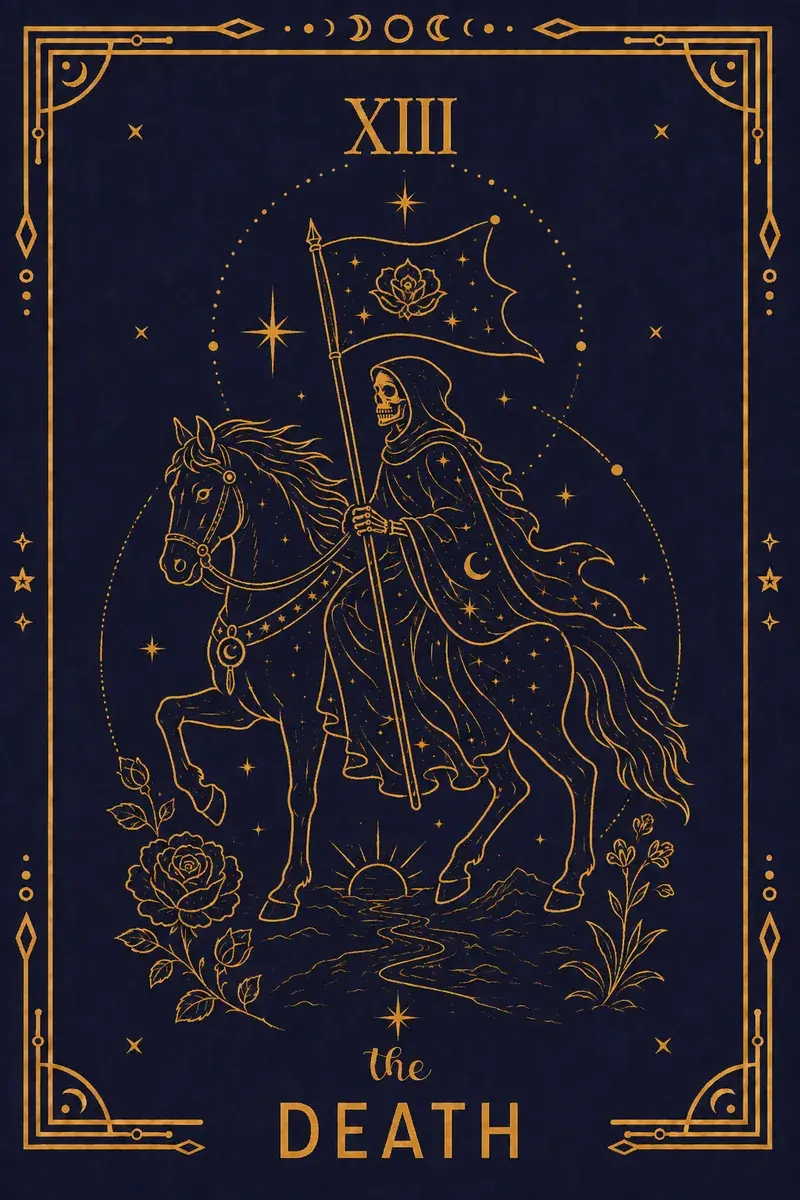
 Death
DeathDeath · Yes or No
Is Death a yes or a no?
Death in a yes/no reading, plus why the answer is less binary than the question wants it to be.
No
This card leans no. It carries obstruction, ending or delay, and in a straight yes/no draw most readers take it negatively.
Death is ending as transformation. It is the most feared card in the deck and one of the most consistently constructive: something concludes so that something else can exist.
This needs saying first and plainly, because it is why most people are reading the page: it very rarely refers to physical death, and no responsible reader treats it as a prediction of one. A deck cannot know that and does not claim to. Anybody who tells you otherwise is doing something other than reading tarot.
The picture is a triumphal procession rather than a slaughter. A king lies dead, a bishop pleads, a child kneels unafraid, and the sun is rising between two towers behind all of it. Rank does not exempt anybody, and the sunrise is the card's actual argument.
Why the answer is not really binary
Yes/no readings are the most popular use of tarot and the one it is worst suited to. A seventy-eight card deck built to describe nuance is being asked for one bit of information, and most of what it knows is discarded in the process.
A more useful version of the same draw: read Death as what shape this takes, not whether it happens. A definitive ending. A chapter closes and will not reopen. Resisting it costs more than accepting it.
The important nuance is about timing: what is being cleared away was already over. The card is the acknowledgement rather than the cause, and it typically arrives some time after the thing itself finished, for somebody who has been maintaining it.
In an advice position it asks for a clean line rather than a gradual withdrawal, on the grounds that the drawn-out version costs both people more. That is demanding advice and the card does not soften it.
Reversed
Reversed, the lean weakens or inverts. Clinging to what has finished. A transition stalled by refusal. It can indicate fear of change so strong it has become the problem, or a slow, dragged-out ending that a clean cut would have ended kindly.
The reversal is where the real difficulty of this card sits. Upright it is over; reversed it is over and is being carried, which takes continuous effort that is invisible to everybody including the person doing it.
Also read for an ending happening at somebody else's pace, which is a genuinely hard position and not a failure of nerve. The card does not always describe a choice.
Draw it for yourself
Reading about a card is not the same as drawing one. A single-card reading takes about a minute and answers your question rather than a general one.